Language & Access · CLSM Framework
We Call It a State Test Score. But How Much of It Is English?

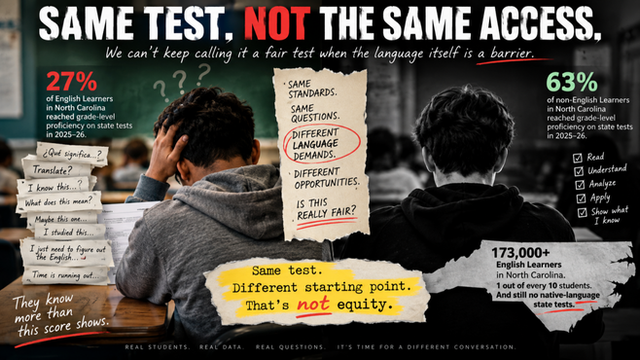
North Carolina just released its 2025–26 testing results. Across EOG and EOC assessments, 59.2% of students reached grade-level proficiency, the highest statewide result in the last three years. Biology jumped eleven percentage points in one year. Math improved. Science improved. There is a lot in the newest data that North Carolina schools should feel good about.
But there is another number in the data that I cannot ignore.
Across tested subjects and grade levels, English Learners were at about 27% grade-level proficiency. Students who were not English Learners were at about 63%.
That is roughly a 36-point difference.
At the same time, North Carolina reported that 36% of English Learners made their expected progress in English or exited English Learner status in 2025–26, the highest rate in three years.
So these students are learning English. They are making progress in English. Yet when we move over to academic testing, there is still this enormous difference in proficiency.
Before we build another intervention around those numbers, before we say students are not mastering the standards, and before we sit around another table looking at subgroup data and trying to figure out how to close the gap, I think we need to ask a question that we probably should have been asking more often.
How much of an English Learner's state test score is actually measuring the content, and how much of it is measuring English?
I teach multilingual students. I know what it looks like when a student does not understand the content. I also know what it looks like when a student understands the content and does not have enough English yet to show me what they know.
Those are not the same problem.
On a state test, they can look exactly the same.
North Carolina's major state assessments are given in English. Biology is English only. Math I and Math III are English only. The EOGs are English only. English II is English only. Native-language versions are not available.
North Carolina does allow certain testing accommodations for English Learners. Students who qualify may receive extended time, multiple testing sessions, a word-to-word bilingual dictionary, or a read-aloud accommodation on some Math and Science assessments.
Those supports can help.
But the read-aloud is still in English.
If a student does not understand the English being read, hearing that same English out loud does not suddenly give the student access to its meaning. A word-to-word dictionary can help with an unfamiliar word, but it cannot unpack an entire sentence. It cannot explain syntax. It cannot connect several unfamiliar academic phrases while the student is also trying to remember the content and reason through four answer choices.
And extra time gives the student more time.
It does not give the student another language.
That led me to look harder at why North Carolina's state tests are English only.
NCDPI's testing documents repeatedly point back to North Carolina General Statute §115C-81.45(a). So I went and read it.
The law says that, outside certain exceptions, teachers and principals must conduct classes in English.
Classes.
It is a law about the language of instruction. The section itself does not explicitly say that EOG and EOC assessments must be available only in English.
North Carolina's ESSA plan gives a fuller explanation. The state recognizes Spanish as a language present to a significant extent among North Carolina students. It then explains that because instruction is conducted in English, the state believes “valid and reliable measures cannot be gained from assessments in other languages.”
I understand the thinking behind that.
Students are being taught the North Carolina curriculum primarily in English. They need academic English. They need to learn the vocabulary of the subjects they are taking. I teach in English too.
But I still do not think that completely answers the assessment question.
Why does teaching a subject in English automatically mean that English should be the only language through which a student is allowed to demonstrate their understanding of that subject?
Instruction and measurement are connected.
They are not exactly the same thing.
A teenager who arrives in North Carolina from another country did not begin thinking when they began learning English. They may have been in school for eight, nine, or ten years before they ever walked into one of our classrooms. They had teachers before us. They read things before us. They solved problems, learned science, studied history, built vocabulary, developed opinions, made inferences, and learned how to reason before us.
Some of that knowledge may exist primarily through Spanish.
That does not make the knowledge less real.
A student may already understand fotosíntesis. They may understand what plants do with light energy, how glucose is produced, and how that process connects to an ecosystem.
Then they come to us and learn the word photosynthesis.
Learning the English word matters. Of course it does.
But the English word did not suddenly create the science inside that student's head.
The science was already there.
Now imagine that student taking the Biology EOC.
She understands the concept. Then she sees a paragraph in academic English followed by a question asking which conclusion best explains how a change in environmental conditions could affect a biological process.
Before she can even think about Biology, she has another problem to solve.
What does best explains mean here? What does affected by refer to? Does environmental condition mean what I think it means? Which part of this paragraph actually matters? What was the question asking again?
She may be decoding vocabulary, working through sentence structure, connecting English terminology to Spanish terminology she already knows, holding all of those pieces in working memory, and then finally trying to reason through the Biology.
The English-dominant student beside her may spend almost none of that mental energy figuring out what the sentence means. That student gets to spend most of it thinking about Biology.
We gave both students the same test question.
That makes the test uniform.
It does not necessarily mean we gave both students the same cognitive task.
Then the multilingual student answers incorrectly.
The computer does not know she understands photosynthesis. It does not know that she could explain the entire process in Spanish. It does not know whether the problem was Biology, English vocabulary, sentence structure, or the amount of information she was trying to hold in working memory.
It records one thing.
Incorrect.
Enough incorrect answers become a score. The score becomes a proficiency level. The proficiency level becomes subgroup data.
Then adults sit around tables looking at the data and trying to figure out why the subgroup is struggling.
I think we need to look one step earlier.
What did the assessment actually measure?
That question matters because North Carolina places a lot of weight on these numbers. EOG and EOC results feed into the state's accountability system and school performance grades. EOC scores also count as at least 20% of a student's final course grade.
We use these scores to describe student achievement. We use them to identify gaps. We use them to decide where intervention is needed. We use them when talking about schools, teachers, districts, and groups of students.
That means we need to be pretty confident about what is inside the number.
North Carolina now has more than 173,000 English Learners, representing more than one out of every ten students in the state.
This is not a tiny population sitting on the edge of the education system.
And North Carolina is not being asked to invent a completely new idea.
As of 2025, 35 states and Washington, D.C. offered at least one native-language state assessment. Almost all of those jurisdictions offered something in Spanish. Math was the most common subject, followed by Science.
Researchers identified 82 individual native-language assessments across the country. Thirty-six of those used some form of bilingual presentation.
Some states use stacked translations, where the English and Spanish appear together. Others allow students to toggle between languages. Some offer a separate Spanish version.
Alabama uses stacked Spanish translations in Math and Science. Ohio offers bilingual translations in Math, Science, and Social Studies. Washington offers bilingual versions in several languages. California provides bilingual access on statewide Math assessments.
So this is not really a question of whether bilingual assessment can exist.
It already does.
The question for North Carolina is whether our current English-only approach is giving us the most accurate information possible about multilingual students.
Federal reviewers have already raised that concern. During review of North Carolina's ESSA plan, reviewers specifically questioned whether English-only assessments accurately represented the achievement of students who were not yet proficient in English.
That is basically the question I am asking from inside a classroom.
Are we seeing what these students actually know?
Because when I look at the newest proficiency data, I do not think we should automatically assume the entire gap represents a lack of content knowledge.
The gap is real. But there are a lot of things inside it.
Prior schooling matters. Interrupted education matters. Poverty matters. Attendance matters. Instruction matters. Opportunity to learn matters. English proficiency matters.
I am not arguing that language explains the entire difference between English Learners and non-English Learners.
It obviously does not.
I am arguing that if language is one of the variables, we should know how much.
Right now, an English-only content assessment does not make that easy to separate.
And that matters instructionally.
If a student does not understand photosynthesis, I need to teach photosynthesis.
If a student understands photosynthesis but cannot independently process the English used in the question, teaching photosynthesis again is not fixing what went wrong.
I would be treating the wrong problem.
Students can spend a lot of time being remediated in content they may already understand when what they actually need is continued language development and stronger connections between the concepts they know and the English used to describe them.
That is time they could have spent learning something new.
This is also why my own classroom has moved so heavily toward bilingual content.
Almost everything I create for my students is bilingual.
Most of the time, the English is on top and the Spanish is directly underneath it. My guided notes are built that way. My vocabulary is built that way. Questions, quizzes, recall activities, directions, and classroom activities are built that way.
I do not remove the English.
My multilingual students still see it because they need it. I want them learning the English terminology while they are learning the content.
But they also have Spanish available when they need it.
There are times when I separate the languages into two documents. Long reading passages are often easier that way. Long directions may be separated too. Putting both languages on the same page can eventually create so much text that the support itself becomes overwhelming.
That is part of the framework I have spent the last year developing in my classroom.
CLSM: Cognitive Load, Language, Structure, and Memory.
Those pieces are constantly interacting.
Language gives students access to meaning.
Structure determines whether that support is actually usable.
Memory matters because words are retrieval cues. A student may already have an entire network of knowledge attached to the word federalismo while the newer word federalism has not fully connected to it yet.
And Cognitive Load matters because working memory only has so much room.
None of that means my multilingual students receive easier work.
The Spanish version is not the easy version.
If we are studying the Reformation, they still have to understand the Reformation.
If we are studying federalism, they still have to understand federalism.
If they are analyzing a historical source, they still have to analyze it.
The academic expectation stays the same.
What changes is access.
That difference has changed the way I think about testing.
If a student misses one of my Civics questions because they do not understand the concept, that gives me useful information.
If they understand the concept in Spanish and miss the question because they could not understand the English sentence I used to ask about it, that gives me completely different information.
Those students can click the exact same wrong answer.
I get to stand beside them and figure out why.
A state test does not.
That is why I think North Carolina should at least seriously study what bilingual state testing could look like.
Not every assessment needs the same solution, and nothing about this would be perfect.
But we have realistic options.
North Carolina could begin with Spanish in subjects where English proficiency is not supposed to be the primary thing being measured, such as Math, Science, or Biology. The English question could stay on the screen with an equivalent Spanish translation underneath it. Students could have the option to toggle between languages instead. The state could begin with students at particular WIDA proficiency levels or with newcomer students.
Then study it.
Compare English-only performance with bilingual-access performance.
Look at what happens at different WIDA levels.
Look at how many years the student has been in U.S. schools.
Look at whether the difference between English-only and bilingual testing gets smaller as English proficiency increases.
Look at whether certain kinds of test items are more heavily affected by language than others.
Maybe the differences would be smaller than I think.
That would be valuable information.
Maybe they would be much larger for beginning English Learners.
That would be valuable information too.
Either way, we would have evidence instead of assuming that the current system is already giving us the clearest picture possible.
And yes, English II is more complicated.
If the goal is to determine whether a student can independently read and analyze complex English text, then the student has to interact with complex English text. A Spanish translation cannot simply replace the English II EOC and be treated as the exact same measure.
But even there, I think we need to be careful about what we say the score means.
A multilingual student may be able to identify an argument, recognize evidence, make an inference, understand theme, and analyze a text very well in Spanish while not yet being able to perform those same tasks independently with grade-level English.
That tells me something important about the student's current English literacy.
It does not automatically tell me that the student lacks the underlying reading and thinking skills.
Maybe for some students we need both pieces of information.
What can this student currently do in English?
And what can this student actually do as a reader?
If those answers are very different, that is useful information for a teacher.
North Carolina already recognizes English proficiency as something worth measuring separately. English Learners take WIDA ACCESS specifically to measure listening, speaking, reading, and writing in English, and English-language progress is tracked separately in the accountability system.
So we already understand that English development is its own thing.
That is why I struggle with how easily English proficiency can become an invisible ingredient inside every other state assessment.
Fairness does not mean making the test easier.
It does not mean lowering the standard.
It does not mean pretending every multilingual student knows every answer.
They don't.
Multilingual students can have content gaps just like anyone else.
What I want is to know that the gap is actually there before we start trying to fix it.
I want rigorous content. I want students challenged. I want them learning English. I want them developing academic vocabulary, reading difficult material, reasoning, analyzing, and being held to high expectations.
I also want them to have the best opportunity we can reasonably give them to show what they know.
Those goals can exist together.
No assessment system will ever perfectly capture everything happening inside a student's brain. Translation will create its own challenges. Bilingual assessments would require careful development, professional translation, transadaptation, field testing, validation, and psychometric review.
That is real work.
But the fact that a solution is complicated is not a reason to stop asking whether the current system is good enough.
There are more than 173,000 English Learners sitting in North Carolina classrooms.
Spanish is already recognized by the state as a language present to a significant extent.
Federal reviewers have already questioned whether English-only assessment accurately represents the achievement of students who are not proficient in English.
Thirty-five states and Washington, D.C. already provide some form of native-language assessment.
And North Carolina's newest data still show a very large proficiency gap between English Learners and students who are not English Learners.
I think that is enough reason to revisit the question.
Not another conversation about how to get multilingual students to do better on an English-only test.
A conversation about the test itself.
About what it measures.
About what it cannot measure.
About whether bilingual access in certain subjects could give us better information.
And about whether the data we are using to make decisions about these students really gives them the best opportunity to show us what they know.
Because somewhere in North Carolina, a student is going to know the science and miss the English.
The score will not know the difference.
The spreadsheet will not know the difference.
And if we never ask the question, neither will we.
If we are going to use these scores to decide what students need, how schools are performing, where achievement gaps exist, and what needs to be fixed, then I think we owe multilingual students something pretty basic.
We should make every reasonable effort to be sure that when we say a student does not know something, they actually did not know it.
Originally published on LinkedIn on September 30, 2026.