Classroom Practice · CLSM Framework
Some Students Already Know the Rules

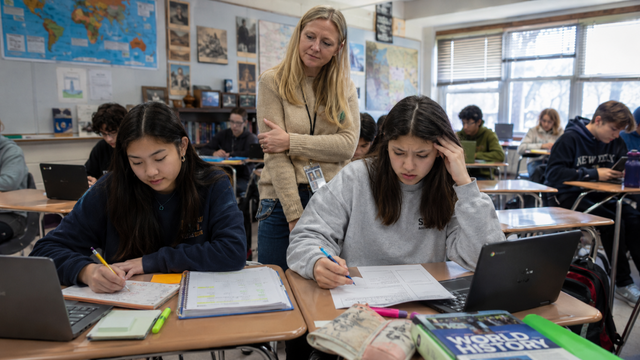
A teacher can hand the same assignment to twenty-five students and assume everyone received the same task.
They didn’t.
One student sees “Use evidence to explain why this empire became powerful” and already knows roughly what the finished answer should look like. They know what counts as evidence, how much explanation is probably enough, what kind of sentence should come first, and that the word explain means the teacher wants more than a fact.
Another student is still trying to figure out what the directions are asking.
They may know just as much about the empire.
That part is easy to miss.
School has its own language, routines, habits, shortcuts, expectations, and unwritten rules. Students spend years learning those rules alongside math, history, science, and English, but we rarely treat that knowledge as part of what they are learning.
Eventually some students become extremely good at it.
They can walk into a classroom and figure out a teacher pretty quickly. They notice what gets graded carefully and what gets checked for completion. They know how to read a rubric without reading every word of it. They can tell when something is probably going to appear on a test. They understand that “show your work” means one thing in math and something completely different in history. They know how much effort an assignment probably requires before they ever begin it.
None of this makes them less intelligent or less deserving of their success.
It means they have developed expertise in an environment they spend thousands of hours inside.
And expertise changes a task.
That may be one reason two students can sit beside each other, receive identical directions, have access to the same materials, and still experience completely different levels of difficulty.
For one of them, most of the structure is already familiar.
For the other, the structure itself is part of the assignment.
That distinction gets especially interesting when grades enter the picture.
A grade might tell me that a student understands historical causation. It may also tell me that the student understood my directions, remembered the deadline, knew how to use the rubric, recognized what kind of response I wanted, organized their time, navigated Google Classroom, interpreted academic vocabulary correctly, and figured out what to do when they got stuck.
All of those things matter in school.
They are also different things.
That gets harder to untangle now that AI is sitting in the middle of academic work.
A student who already knows how school works has another advantage when using AI because they have something to judge the output against.
They know when the response sounds too generic.
They recognize when evidence does not actually support the claim.
They know the assignment wants analysis instead of summary.
They know that a beautiful paragraph can still answer the wrong question.
A student who does not yet understand those rules can receive the exact same AI response and see something that looks finished.
The technology is the same.
The judgment behind its use is not.
That matters more than it might seem.
There has been a lot of discussion about whether AI will make knowledge less important because information can now be generated instantly. I wonder whether the opposite may happen in some situations. The more easily a tool can produce an answer, the more valuable it becomes to know what a good answer actually looks like.
That requires knowledge of the subject.
It also requires knowledge of the task.
And increasingly, it requires knowledge of the system around the task.
School has always contained that second layer.
AI just makes it harder to ignore.
There is research around this that gives the problem a much bigger frame. Sociologists have studied cultural capital in education for decades, including the ways students learn how to navigate institutions, communicate with teachers, understand expectations, and use information that may never appear in formal curriculum.
More recent work has continued examining what researchers sometimes describe as knowledge of the educational system itself.
That phrase interests me because it describes something teachers see constantly without necessarily naming it.
There are students who know school.
They know how to recover from a low grade.
They understand that missing one assignment is different from failing a course.
They know when it makes sense to email a teacher.
They know what office hours are once they reach college.
They understand what “study” actually involves beyond looking at a page again.
They know that feedback is something you can use on the next assignment rather than simply a comment attached to the last one.
None of this arrives automatically with intelligence.
It gets learned somewhere.
Family can be one source. Previous teachers can be another. Older siblings, coaches, counselors, friends, trial and error, and years of academic success can all contribute.
The student who has been successful in school for a long time also gets something that is difficult to measure: more practice being successful in school.
They recognize patterns faster because they have seen the patterns before.
That sounds almost ridiculously simple, but it changes what happens cognitively.
A familiar task demands less attention just to understand the structure.
That leaves more mental space available for the actual content.
This is where the issue starts intersecting with CLSM in a way that matters to me.
Cognitive load is usually discussed in terms of the amount of information working memory is trying to handle. But school itself creates cognitive load.
Directions create it.
Unfamiliar formats create it.
Academic language creates it.
Technology creates it.
Switching between platforms creates it.
Trying to decide what the teacher means creates it.
Trying to remember whether the assignment is due at midnight or before class creates it.
A student can arrive at the intellectual part of the lesson with part of their attention already occupied.
Structure can reduce some of that.
Predictable routines can reduce some of it too.
Students knowing where assignments are located, what a normal lesson looks like, how notes are organized, or what kind of response a question is asking for frees attention that would otherwise be spent decoding the environment.
That is one reason structure matters so much in my classroom.
There is another side to it, though.
A student can become so familiar with one classroom system that success starts depending on that system staying intact.
Change the format and suddenly the student who seemed completely independent has no idea how to begin.
That tells us something too.
Knowing the routine and knowing how to build a routine are different skills.
The same is true with academic language.
Teachers use words such as analyze, evaluate, justify, explain, and compare constantly.
Those words look ordinary after years of teaching.
They are doing a remarkable amount of work inside an assignment.
“Analyze” tells a student what kind of thinking to perform.
“Justify” tells them evidence probably needs to appear.
“Evaluate” suggests judgment.
A student who understands those signals gets information from the directions that another student may not even notice is there.
Then we grade the responses.
This is where I get uncomfortable with overly simple descriptions of achievement.
“High-performing student.”
“Low-performing student.”
“Advanced.”
“Struggling.”
Those labels can be useful shorthand, but they compress a lot of different things into one description.
A student can know the content and struggle to produce the expected academic form.
Another can become incredibly skilled at producing the form while understanding the content less deeply than the grade suggests.
Most students probably sit somewhere in the messy middle.
That matters for assessment.
It matters even more now because schools are trying to decide what student work means in an era when polished products can be created with very little visible evidence of how they were produced.
An essay cannot tell me by itself how much of the thinking belonged to the student.
A presentation cannot either.
A correct answer gives me information, but not necessarily the whole path that produced it.
The ability to navigate school has always influenced academic performance.
AI adds another navigation problem on top of the ones already there.
Students now have to figure out when AI is allowed, how much help is acceptable, whether they should disclose its use, which teachers permit it, which assignments prohibit it, how to verify what it produces, and how much of the work they can hand over before the assignment stops representing their own understanding.
Those rules are still shifting.
Students who are already skilled at reading institutional expectations may have an easier time reading these too.
Which makes me wonder about something much more basic than AI policy.
How much of school success depends on information we never deliberately teach?
How to approach an unfamiliar assignment.
How to decide what matters in a reading.
How to study something that will need to be recalled later.
How to use feedback.
How to break down a large task.
How to know when you actually understand something.
How to ask for help before the situation becomes a crisis.
We tend to call many of those things habits.
Maybe some of them deserve to be treated as curriculum.
Because when one student already knows the unwritten rules and another does not, giving them identical directions does not necessarily give them an identical opportunity to show what they know.
And I don't think the solution is to make every assignment easier or explain every possible decision in advance.
Students eventually have to deal with ambiguity. They have to organize things for themselves. They need to encounter work that does not arrive with every step already arranged.
But it seems worth asking whether they have been taught the tools needed to do that before we interpret difficulty as inability.
There is a student question teachers hear constantly:
“How many sentences does this have to be?”
It is easy to hear that as an attempt to do the smallest possible amount of work.
Maybe it is.
But there is another possibility.
The student may be asking for the rule because they cannot see the boundary of the task.
A student who already understands academic writing does not need the boundary written down.
They can estimate it.
That tiny interaction captures a much bigger difference between students than I had really considered before.
Some students are learning the subject.
Some are learning the subject while also learning what school expects a person to do with it.
By the time both pieces become automatic, we usually stop noticing either one.
That may be part of what makes the hidden curriculum so powerful.
The students who know it rarely have to think about it.
The adults who know it rarely remember learning it.
And everyone else is expected to somehow figure it out while the gradebook keeps moving.
Originally published on LinkedIn on September 9, 2026.