When Support Becomes Dependence

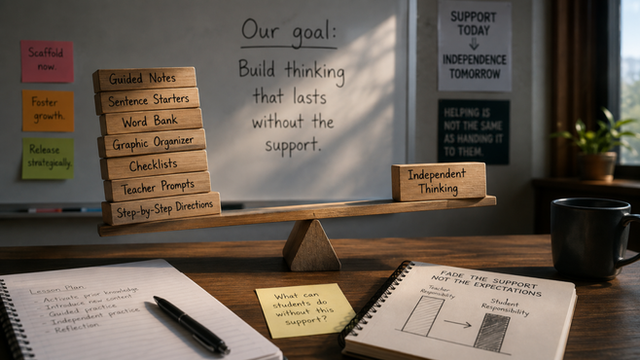
There is a moment in teaching that is easy to misread.
A student has been successful for weeks. They have completed the work, used the organizer, followed the checklist, answered the questions, maybe even improved their grade. Then one small thing changes. The format looks different. The sentence starter is gone. The directions are shorter. The teacher does not immediately walk over and prompt them to begin.
And suddenly, the student seems stuck.
That moment has always interested me because it forces a harder question than whether the support “worked.” Clearly, it did. The student was able to participate, complete the task, and often show much more than they could have shown without it. The problem is that success with support and independence are not the same thing, and I think schools sometimes treat them as though they are.
I say that as someone who believes deeply in support.
I use guided notes. I use visual organization. I chunk directions. I build routines. I provide sentence starters, bilingual supports, repeated retrieval, and as much structure as I think students need to get into the learning without wasting all of their attention trying to figure out what they are supposed to be doing. I do not see those things as shortcuts. I see them as part of the design of the lesson.
But good support can hide things too.
It can hide how much of the task the learner still does not know how to manage alone. It can make performance look more stable than it actually is. Sometimes the student understands the content but still depends on the structure around it. Sometimes the structure has become so familiar that neither the student nor the teacher notices how much work it is doing.
That does not make the support bad.
It just means we have to be careful about what we think we are seeing.
A student who writes a strong paragraph with a sentence frame may understand the concept very well. A multilingual learner may have a level of reasoning that is much more advanced than what they can currently produce in English. A student who uses a graphic organizer may be able to make excellent connections once the information is placed somewhere visible instead of being held in working memory. In those situations, taking the support away does not reveal “true ability.” Sometimes it just puts the barrier back.
That is where the usual conversation about independence gets muddy.
We tend to talk about independence as if it means doing everything alone, but adults do not live that way. We use calendars because we do not want to remember every appointment. We set alarms. We write grocery lists. We use GPS in places we have driven before. We use calculators, spellcheck, reminders, templates, notes, and search tools. Nobody looks at an adult checking a calendar and concludes that the adult has failed to develop independence.
We build systems around ourselves because human cognition has limits.
Students are human too.
So the question cannot simply be, “Can they do this without help?”
The better question is what kind of help they are using and what that help is doing.
That sounds simple until you watch it happen in a classroom.
Take a checklist. A checklist can be an incredibly effective support for a student who has trouble holding several steps in mind at once. Instead of using working memory to remember what comes next, the student can use that mental space for the actual content. That is exactly what we want. But over time, I have also seen students become so used to having the steps prepared for them that they stop trying to organize a task until the checklist appears.
The same support that made the work possible can begin to define the conditions under which the student believes the work is possible.
That is the part we do not talk about enough.
It happens with guided notes too. Students can learn more during a lesson because they are not scrambling to copy every word on a slide. Their attention can stay with the explanation instead of bouncing between listening, deciding what matters, writing, and trying not to fall behind. That is one of the reasons I use them.
But guided notes also make decisions for the learner. Someone else has already decided what is important, how the information should be organized, and where each idea belongs.
At some point, students also need practice making those decisions.
Not necessarily while they are first learning difficult content. That would defeat the purpose. But eventually, they need opportunities to look at information and decide what deserves attention without every important idea already waiting inside a box.
The trouble is that the moment when support should begin to change is rarely obvious.
Students do not wake up one morning fully ready to give it up.
Some supports should not disappear at all. A student may need assistive technology for years. A multilingual learner may continue to use bilingual resources while academic English develops. A student with executive-function difficulties may always benefit from external organization. There is nothing inherently wrong with that. Independence does not require pretending our brains have no limitations.
What matters is whether the support is helping the learner do the thinking or doing the thinking in the learner’s place.
I keep coming back to that distinction.
Imagine a student writing an argument about a historical event. The first time, I might give them a fairly detailed organizer. There is a place for the claim, a place for evidence, another space for reasoning. That structure lets the student focus on the quality of the argument instead of trying to build the architecture of the entire response while also thinking about the content.
Later, I might give them less.
Not because the earlier support was somehow too easy, but because now I want to see whether some of that structure has begun to move into the student’s own thinking. Maybe the organizer becomes a few blank boxes. Maybe there is no organizer at all, but I ask them to sketch out how they plan to organize the response before they begin.
That small change tells me much more than another perfectly completed organizer ever could.
Can the student recreate the structure?
Can they recognize what belongs where?
Can they make a decision without waiting for the page to tell them what comes next?
This is where support becomes interesting because the purpose of the support begins to change. At first, it creates access. Later, it becomes practice. Eventually, it may become something the learner can create for themselves.
That last part matters.
I think one of the strongest forms of independence is not learning to live without supports. It is learning to build your own.
A student who once needed my checklist may eventually make their own checklist.
A student who depended on a graphic organizer may eventually sketch one on scrap paper before writing.
A student who needed sentence starters may begin creating the opening sentence themselves because the structure has become familiar.
The support did not vanish. It moved.
Some of it moved from the teacher to the student. Some of it moved from the page into memory. Some of it became a strategy the student can use whenever they need it.
That feels more realistic to me than the idea that successful learning should eventually leave the student needing nothing at all.
It also changes how I think about rigor.
There is still a tendency to equate fewer supports with higher expectations. Sometimes removing support does raise the level of thinking. Other times it simply adds difficulty that has nothing to do with what we wanted students to learn.
If I remove language support from a student who understands the history but is still developing English, I may make the assignment harder without making the historical reasoning more demanding. If I remove a visual structure from a student who struggles with working memory, I may end up measuring how much information they can hold at once rather than how well they understand the concept.
That is not rigor. It is interference.
But the opposite can happen too.
If every task is always organized for the student, every response is always started for them, every question is always broken down before they have a chance to wrestle with it, then we may slowly remove the very opportunities that help students learn how to manage difficulty.
That is why I do not think the answer is “more support” or “less support.”
The harder work is figuring out which part of the task belongs to the support right now and which part the learner is ready to take back.
Sometimes the answer surprises us.
A student who looks dependent may actually understand far more than we thought once the right barrier is removed. Another student may look completely independent because they have learned how to follow a familiar routine, but struggle the moment the routine changes.
That is why transfer matters so much.
Change the wording.
Change the format.
Ask the same kind of thinking in a different context.
Close the notes.
Take away one prompt instead of all of them.
Give the student a little more empty space and see what they do with it.
Those moments are often more informative than another completed assignment.
They show us what has started to belong to the learner and what still belongs to the environment we built around them.
And that is where I think support becomes much more than an accessibility question.
It becomes a learning question.
The goal is not to prove that a student can survive without help. There is nothing especially educational about making someone struggle simply because we can.
The goal is to notice when a support is opening the door to thinking and when it has quietly started taking over part of the thinking we hoped the student would eventually do.
That line moves.
It changes with the learner, the task, the content, the language demands, the day, and sometimes even the hour.
There is no perfect formula for it.
Maybe that is why this part of teaching requires so much judgment.
We are not only deciding how to help students succeed.
We are also deciding when to leave just enough room for them to discover that they can do a little more than they could before.
Originally published on LinkedIn on September 2, 2026.