World History · Guided topic practice
The Commission Desk
A city has money for art. Who shapes what gets made?
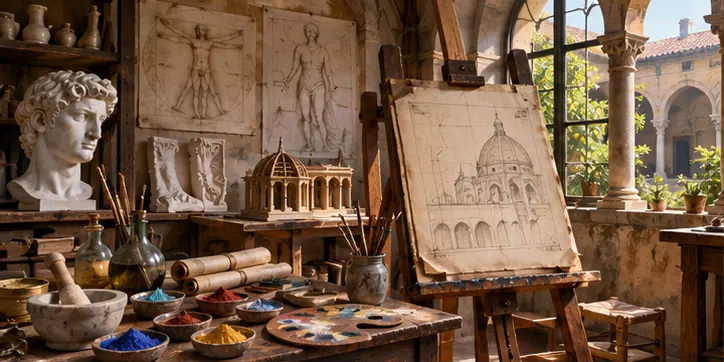
Your starting point
Connect patronage, humanist study, and institutions in Renaissance cultural production.
The Renaissance involved renewed engagement with Greco-Roman texts and forms alongside continuing religious traditions. Humanist study emphasized language, rhetoric, history, and moral questions. It did not require every scholar to reject religion. Cities, courts, churches, and wealthy households supported different kinds of cultural production.
Patronage mattered because artists and scholars needed time, materials, access, and income. A commission could communicate devotion, prestige, civic identity, or dynastic ambition. Artists also made choices within those relationships. A completed work is evidence of both its production context and particular creative decisions, not a simple photograph of society.
At this fictional commission desk, compare three proposed projects and evaluate what each can reveal about power and ideas. You are not choosing the “best civilization.” You are asking how resources, institutions, and intellectual interests help explain why certain works are produced and circulated.
Take your time. You can reopen these notes during any task. Work stays on this page; leaving or reloading clears it.
Course connections
Reviewed NC references: WH.B.1.1
Compare the activity’s scope with your own course requirements. These connections identify practice opportunities; they do not establish full standards mastery or a match for every state.