World History · Guided topic practice
The Workshop’s Unfinished Labels
Use features as evidence without turning them into a checklist for an entire era.
Your starting point
Explain how artistic techniques, classical study, and print circulation contributed to cultural change.
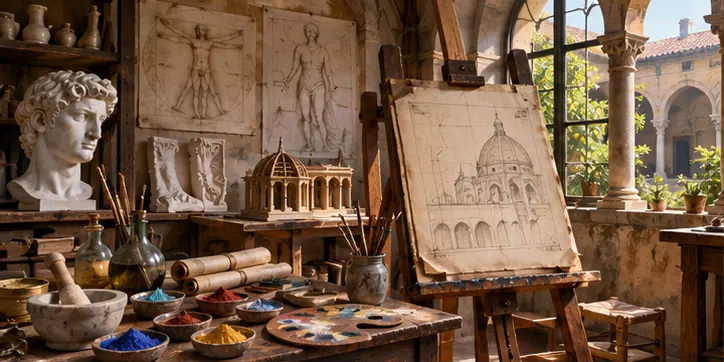
Renaissance art and learning included varied interests in classical antiquity, observation, human experience, and methods for representing space. These features did not appear identically in every work or region. Religious subjects remained prominent. Identifying one feature is the beginning of interpretation, not proof that every characteristic belongs to every object.
Printmaking helped images and designs circulate beyond a single workshop. Artists could study, compare, and adapt forms encountered through prints or travel. Dürer’s work and writings connect artistic practice with geometry, human proportion, and exchange across regions. These connections show how techniques and ideas can develop through movement.
The unfinished labels are fictional descriptions, not images you are expected to see. Read the stated visual evidence, identify the feature it supports, and decide what additional information would be needed. Your final label should explain a relationship between a technique and its effect rather than simply list vocabulary.
Take your time. You can reopen these notes during any task. Work stays on this page; leaving or reloading clears it.
Course connections
Reviewed NC references: WH.B.1.2 · WH.G.1.2
Compare the activity’s scope with your own course requirements. These connections identify practice opportunities; they do not establish full standards mastery or a match for every state.